31 CRNA Schools That Consider Your Last 60 Credit Hours
Verified directly from each program’s admissions page. Updated April 2026.
If your cumulative GPA is below 3.0, you've probably been told CRNA school isn't realistic. That's not the full picture. Of the 155 accredited CRNA programs in the United States, 31 of them give meaningful weight to your last 60 credit hours of coursework — meaning the GPA from your most recent semesters can carry you past programs that would otherwise screen you out on cumulative alone.
Short answer
Yes — some CRNA schools consider your last 60 credit hours instead of relying only on cumulative GPA. As of April 2026, CRNAPathway verified 31 accredited nurse anesthesia programs that give meaningful weight to last 60 credit hours, either as the primary GPA metric, an alternative qualifying metric, a weighted review factor, or a discretionary review factor.
This page is the verified list. Every program below was checked directly against its current admissions page in April 2026. No outdated blog posts, no secondhand claims. Where the policy was ambiguous, the program was excluded.
One important caveat before you read further: "uses last 60" means very different things at different schools. Some programs use it as their sole GPA metric. Others let you qualify with either cumulative or last 60. A few weight it alongside other GPAs in a composite score, and one program only considers it at the director's discretion. The category column tells you which mechanism applies to each program — and that distinction matters more than most applicants realize.
Track up to 12 Last 60 schools for free deadline reminders, or choose Program Watch for ongoing changes and a personalized monthly update.
Your CRNA school list changes. We keep track of it.
Save the Last 60 programs you’re considering. Program Watch monitors deadlines, application openings, and requirement changes—and sends you one personalized update each month.
No spam. Unsubscribe anytime.
Not Sure where you Should Apply?
It takes a long time to sift through all of the program requirements - we do it for you, and then some. We provide an overall assessment, tell you which schools best suit your overall profile, highlight your gaps and priorities - all to help you get accepted. Reviewed and personalized by CRNAs who have been there.
Four tiers, ordered from most to least forgiving. The counts add up to all 31 programs.
Sole metric · 20 programs
Your last 60 GPA is the number they evaluate. Cumulative GPA may be a soft check or not calculated at all.
What this means: Most forgiving. A strong recent run keeps you in the running regardless of earlier grades.
Alternative · 4 programs
You qualify on either your cumulative GPA or your last 60 GPA — meeting one threshold puts you in the review pool.
What this means: A strong last 60 fully substitutes for a weak cumulative for eligibility.
Composite · 6 programs
Several GPAs (cumulative, science, last 60, sometimes graduate) are scored together in an admissions rubric.
What this means: Last 60 helps but doesn’t neutralize a weak cumulative — best for borderline, not low, cumulatives.
Discretionary · 1 program
Considered only at the director’s discretion, usually by written petition.
What this means: Not a guaranteed path. Mayo Clinic is the only program here.
How to read the verified school list
How to read the verified school list
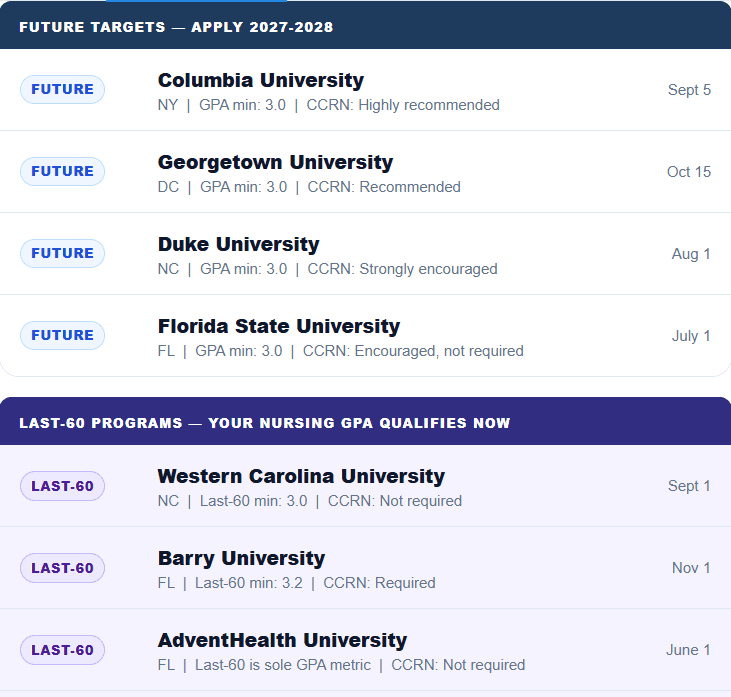
Use the table to compare how each program treats last 60 credit hours. Policy type matters: some schools use last 60 as the main GPA, while others consider it only as part of a broader review.
Use the table to compare how each program treats last 60 credit hours. Policy type matters: some schools use last 60 as the main GPA, while others consider it only as part of a broader review.
A note on what “low GPA” actually means here. Most of these programs still expect 3.0 in your last 60 credits. A handful go higher (Samuel Merritt requires 3.25, Kaiser Permanente 3.2, Endeavor Health 3.5). The programs in this list are not low-bar — they’re high-bar with a more recent measurement window. If you’re working on GPA recovery, your goal is a 3.5+ in your last 60 to be competitive, not just to clear the minimum.
Program
Location
State
Policy Type
Min GPA
How Used
Deadline
Source
AdventHealth University
Orlando
FL
Sole metric
Not specified
Cumulative GPA calculation IS the last 60 credit hours (last 60 used in lieu of cumulative).
3.2 GPA minimum. Reviews both cumulative and last 60 credit hours as part of overall academic profile evaluation. 2 years ICU required. One of PA's stricter programs.
GPA requirement calculated from last 60 credit hours of undergraduate nursing degree. CCRN or CEN with score report required. Rolling admissions with January 15 priority deadline.
Graduate degree GPA and last 60 credit hours both taken into consideration alongside cumulative GPA as part of holistic review. CCRN with score report required.
Reviews overall GPA, last 60 credit hours, and science GPA as part of holistic review process. Blended distance-learning format with Baptist Health Deaconess Madisonville clinical site.
Graduate degree GPA and last 60 credit hours both taken into consideration alongside cumulative GPA as part of holistic review. CCRN with score report required.
Reviews overall GPA, last 60 credit hours, and science GPA as part of holistic review process. Blended distance-learning format with Baptist Health Deaconess Madisonville clinical site.
3.2 GPA minimum. Reviews both cumulative and last 60 credit hours as part of overall academic profile evaluation. 2 years ICU required. One of PA's stricter programs.
GPA requirement calculated from last 60 credit hours of undergraduate nursing degree. CCRN or CEN with score report required. Rolling admissions with January 15 priority deadline.
Know someone rebuilding their GPA for CRNA school? Send them this verified list.
Know someone rebuilding their GPA for CRNA school? Send them this verified list.
Frequently Asked Questions
Frequently Asked Questions
What does "last 60 credit hours" mean for CRNA admissions? It means the program calculates your GPA using only your most recent 60 credit hours of college coursework rather than your full undergraduate record. For most applicants, this captures the final two years of a BSN program plus any post-baccalaureate coursework. Programs that use this approach are giving weight to recent academic performance rather than penalizing applicants for grades earned years earlier.
Can I get into CRNA school with a low cumulative GPA? Yes, if your last 60 credit hours show strong performance. The 31 programs on this list publicly state that they consider the last 60 in admissions, which means a 2.6 cumulative paired with a 3.6 last 60 is a viable application at programs in the “Sole metric” or “Alternative” categories. You’ll still need strong ICU experience, CCRN certification, and a competitive interview — last 60 helps you clear the GPA filter, not the entire admissions process.
How do I calculate my last 60 GPA? Most programs use NursingCAS, which calculates this automatically when you submit your application. You can also estimate it manually by listing your most recent courses chronologically, working backward until you reach 60 credit hours, and computing the GPA using standard 4.0-scale grade points. If a partial semester is needed to reach exactly 60, programs handle this differently — Union University, for example, takes the highest-grade course from that semester.
Does my last 60 credits include graduate coursework? It depends on the program. UAMS allows last 60 from undergraduate OR graduate coursework. Most others use undergraduate only. If you have a master's degree in a related field, contact the program directly to confirm whether graduate credits count toward the calculation.
How often is this list updated? This list was last verified in April 2026. Admissions policies change, so we recommend checking the source link for any program before applying. We update the list at least twice per year and after any major reported policy change. If you've spotted an outdated entry, contact us so we can re-verify.
Which CRNA schools look at last 60 credits? The verified list above includes programs that publicly reference last 60 credit hours or a similar recent-coursework GPA calculation in admissions. Do CRNA schools use cumulative GPA or last 60 GPA? It depends on the program: some use last 60 as the main GPA metric, some allow either cumulative or last 60, and others use it as part of a broader review. What last 60 GPA is competitive for CRNA school? A 3.0 may clear a minimum screen at some schools, but GPA-recovery applicants should usually aim for a 3.5+ last 60 GPA to be competitive alongside ICU experience, CCRN, references, and interview performance.